Imagine your first day as a new nurse. Your manager hands you a checklist, and three letters keep popping up: BLS. Then someone mentions you might need ACLS soon. And didn't you already take a CPR class in college? If you feel a little lost, you are not alone.
The truth is that CPR vs BLS vs ACLS confuses thousands of students, caregivers, and healthcare workers every year. They sound similar, they overlap, and picking the wrong one can waste your money or cost you a job offer. This guide breaks down exactly what each one means and which certification you actually need.
CPR vs BLS vs ACLS at a Glance
Here is the fast answer in one simple table.
Feature
CPR
BLS
ACLS
Who it is for
Everyone
Healthcare workers
Advanced clinical staff
Core skills
Compressions, rescue breaths
CPR plus AED, teams, choking
Meds, airways, heart rhythms
Course length
1 to 2 hours
4 to 5 hours
Multi-hour with skills test
Typical cost
$25 to $80
$15 to $120+
About $189 to $210
Valid for
2 years
2 years
2 years
Prerequisite
None
None
Current BLS card
Think of it like a staircase. CPR is the first step, BLS is the second, and ACLS sits at the top.
What Is CPR Certification?
CPR stands for cardiopulmonary resuscitation. It teaches you the basics of keeping someone alive when their heart stops. You learn chest compressions, rescue breaths, and how to spot the signs of cardiac arrest.
A standard CPR class is short, usually one to two hours, and the card lasts two years. It is built for everyday people, not hospital staff.
This matters more than most folks realize. The American Heart Association reports that over 350,000 cardiac arrests happen outside hospitals each year in the United States, and quick bystander CPR can roughly double a person's chance of survival.
Who Needs CPR (Not BLS)
You likely need a basic CPR card if you are a:
Teacher, coach, or daycare worker
Personal trainer or fitness instructor
Parent or family caregiver
Office safety volunteer
If you do not work directly with patients, CPR is usually enough.
What Is BLS (Basic Life Support)?
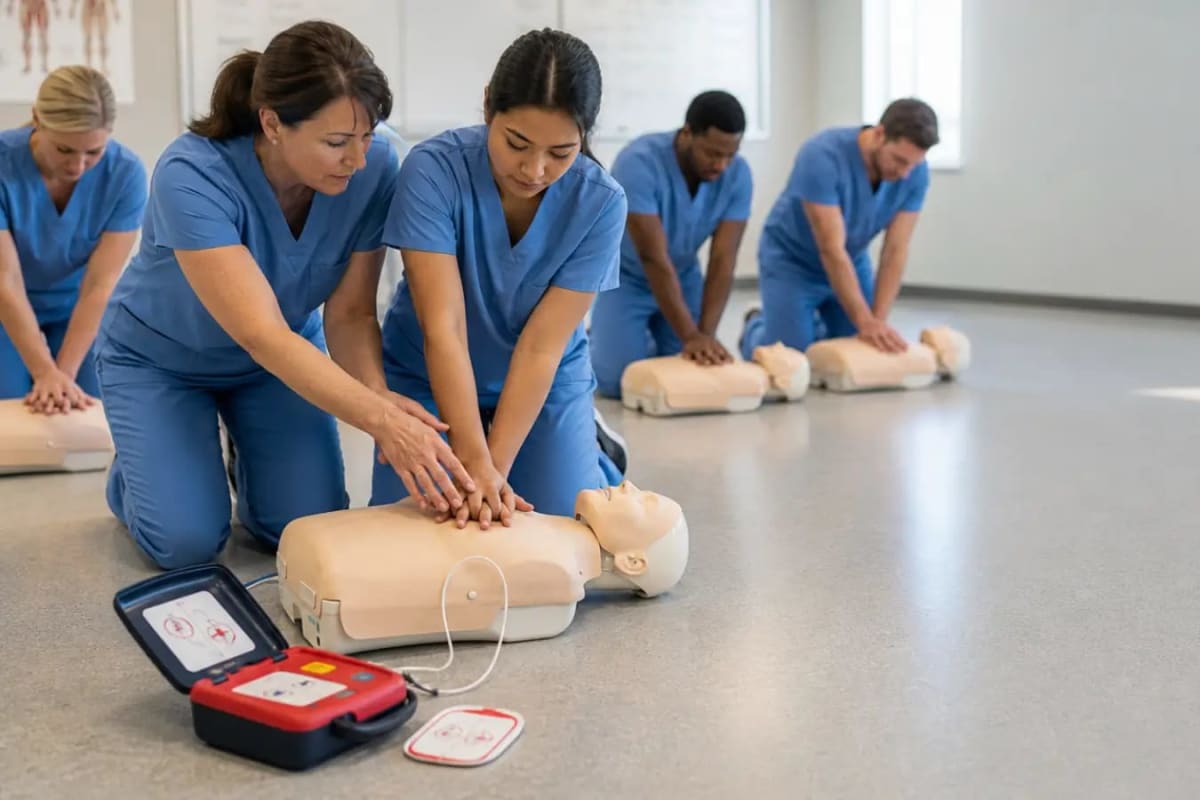
BLS, or basic life support, is the healthcare version of CPR. It includes everything in a CPR class but goes deeper. You practice high-quality chest compressions, AED use, team-based rescue, and clearing a blocked airway.
A BLS course runs about four to five hours and also expires after two years. Almost every hospital and clinic in the country expects staff to keep a current BLS card.
Is BLS the Same as CPR?
Not quite. BLS includes CPR, but CPR does not include everything in BLS. CPR teaches you to help one person on your own. BLS prepares you to work as part of a medical team, switch rescuers smoothly, and use professional tools. If you are a healthcare provider, employers almost always want the BLS version.
What Is ACLS (Advanced Cardiovascular Life Support)?
ACLS stands for advanced cardiovascular life support. This is where things get clinical. ACLS builds on BLS and adds advanced airway management, IV medications, and reading heart rhythms on a monitor.
It is designed for staff who lead emergencies, not just assist. The course is longer and includes a hands-on skills station where you run mock codes.
Can You Take ACLS Without BLS?
In most cases, no. ACLS assumes you already know basic life support cold. You also need to understand ECG interpretation and emergency medications before you walk in. A current BLS card is the standard prerequisite, so always earn that first.
Which Certification Do You Actually Need?
This is the question everyone really wants answered. Here is a simple role-by-role guide for the United States.
Healthcare Providers (RN, CNA, EMT, MD)
CNAs and medical assistants: BLS is usually enough.
Floor nurses and EMTs: BLS, and often ACLS depending on the unit.
ICU, ER, and cath lab staff: BLS plus ACLS, and sometimes PALS for kids.
Doctors in acute care: BLS plus ACLS.
Non-Clinical and Lay Rescuers
Teachers, trainers, parents: basic CPR.
Lifeguards and camp staff: CPR with first aid.
Dental and outpatient front desk: often BLS, since they assist clinically.
A quick rule of thumb: if you touch patients in an emergency, you need BLS. If you give orders or medications during a code, you need ACLS.
AHA vs Red Cross: Which Issuer Do Employers Accept?
Two names dominate this space: the American Heart Association and the American Red Cross. Both are widely trusted, and most US employers accept either one.
The bigger trap is the online-only certificate mill. Some cheap websites sell a card with no hands-on test. Many hospitals reject these on day one.
To stay safe, follow this tip:
Pick an AHA or Red Cross course
Confirm it includes a live, in-person skills check
Ask your future employer which provider they prefer before you pay
The bigger trap is the online-only certificate mill. Some cheap websites sell a card with no hands-on test. Many hospitals reject these on day one.
Cost, Course Length, and Validity Compared
Money matters, so let's be honest about it. Based on 2026 pricing data from training providers like CPR1 and Safety Training Seminars:
BLS ranges from around $15 for basic online modules to $50 to $120+ for blended or in-person classes.
ACLS typically costs about $189 for renewals and around $210 for a new certification, with group rates near $65 to $75 per person.
Basic CPR usually lands between $25 and $80.
Remember, the cheapest online option often misses the required skills session, which means a second cost later.
How Recertification Works
Every card on this list expires after 24 months. You cannot let it lapse and keep working in most clinical roles.
Renewal is faster and cheaper than a first-time course. You refresh your skills, pass a competency check, and get a new card. Set a calendar reminder about 60 days before your expiration date so you never scramble at the last minute.
Where PALS, NRP, and HeartSaver Fit In
You may hear other acronyms too. Here is a quick map so nothing surprises you:
PALS: advanced care for children, common in pediatrics and the ER.
NRP: neonatal resuscitation for newborns, used in labor and delivery.
HeartSaver: the AHA's CPR and first aid course for non-medical workplaces.
Most people start with CPR or BLS and add these only when their job demands it.
FAQ
No. BLS includes CPR skills but adds AED use, team rescue, and airway care for healthcare settings. CPR alone is the simpler, lay-rescuer version.
Most nurses need BLS at minimum. ACLS is required for higher-acuity units like the ICU, ER, and telemetry, depending on your employer.
Generally no. A current BLS card is the standard prerequisite, along with basic knowledge of heart rhythms and emergency medications.
CPR takes about one to two hours, BLS runs four to five hours, and ACLS is a longer course that includes a hands-on skills station.
Most US employers accept both AHA and Red Cross. Avoid online-only cards with no in-person skills test, since many hospitals reject them.
Final Thoughts
Choosing between CPR vs BLS vs ACLS comes down to one thing: what your role asks of you. Everyday helpers need CPR. Healthcare workers need BLS. Advanced clinical staff need ACLS on top. Start at the right step, use a trusted provider, and keep your card current.
The skills you learn here are not just for a checklist. One day they may help you save a life.
Which certification are you working toward right now? Drop a comment below, and share this guide with a friend who is starting their healthcare journey.
Pick the Right Life Support Certification
Get clear, no-nonsense guides on CPR, BLS, and ACLS sent straight to your inbox.