If you've ever stared at the back of a cereal box wondering what "% Daily Value" actually means, you're not alone. Most Americans never get a clear, plain-English breakdown of the US nutrition guidelines, even though our health depends on them. The CDC reports that fewer than 1 in 10 American adults eat enough vegetables every day, and most of us guess our way through meals. This guide explains MyPlate, your daily macros, and how much of everything you really need, without the government jargon.
What Are the US Nutrition Guidelines?
The US nutrition guidelines are the official healthy-eating advice put together by the federal government every five years. They're written for almost everyone in the country aged 2 and older, including pregnant women and seniors. Think of them as the country's nutrition playbook.
Who Creates Them and Why
Two federal agencies write these guidelines together: the U.S. Department of Agriculture (USDA) and the Department of Health and Human Services (HHS). They base every recommendation on a panel of scientists who review the latest nutrition research. The goal is simple: help Americans live longer, healthier lives by eating better.
How They Are Updated Every Five Years
A new edition lands every five years. The current cycle is the Dietary Guidelines for Americans 2025-2030, which builds on the 2020-2025 version. Each update reflects fresh science on chronic disease, child nutrition, and shifting American eating habits.
MyPlate Explained: The 5 Food Groups in Plain English
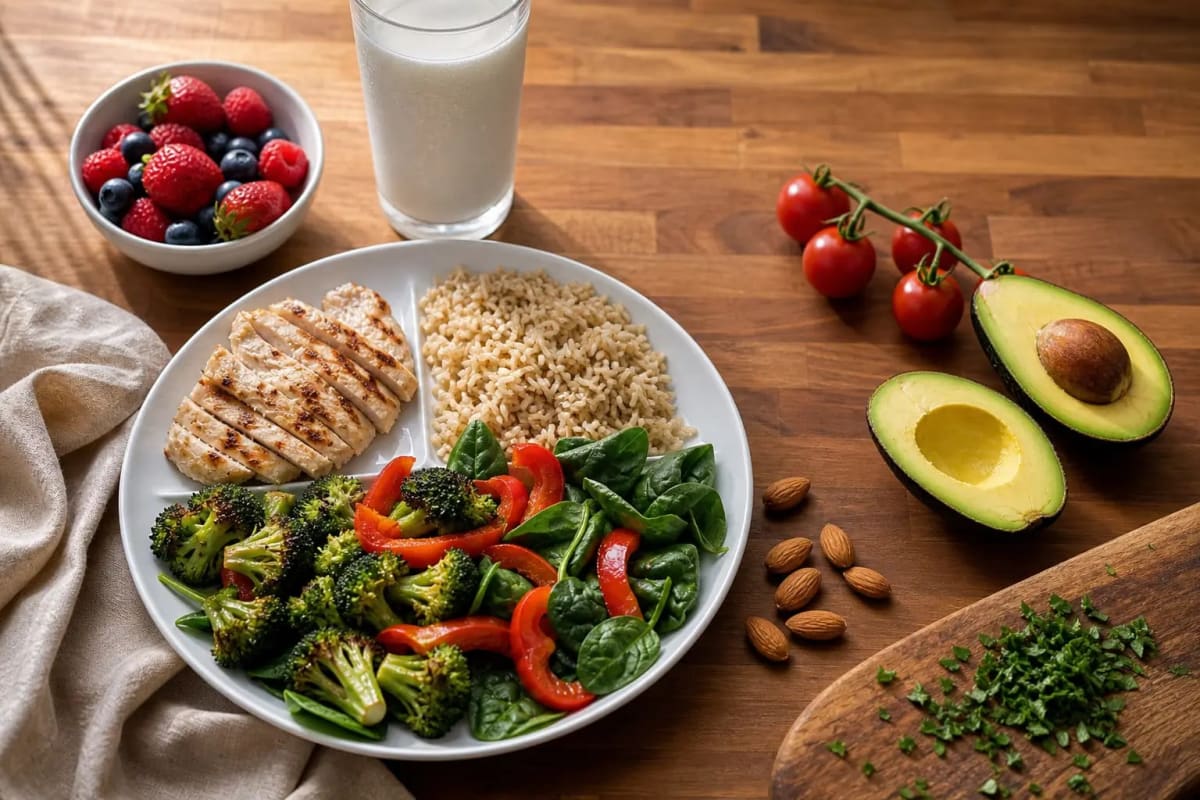
MyPlate is the simple visual that replaced the old food pyramid back in 2011. Picture a dinner plate split into four colorful sections, with a small circle on the side for dairy. Here's what goes where.
Fruits (red section)
Vegetables (green section)
Grains (orange section)
Protein Foods (purple section)
Dairy (blue circle)
Fruits
Fill about a quarter of your plate with fruits. Fresh, frozen, canned in juice, and dried all count. Aim for 2 cups a day for most adults. Whole fruit beats juice almost every time because of the fiber.
Vegetables
This is the biggest section on MyPlate, and most Americans miss the mark badly. According to the CDC, fewer than 10% of US adults hit their daily veggie target. Aim for 2 to 3 cups daily, mixing dark leafy greens, red and orange veggies, beans, and starchy options like potatoes.
Grains (and Why Half Should Be Whole)
Grains take up another quarter of the plate. The official rule is to make at least half of them whole grains. Whole-wheat bread, brown rice, oatmeal, and popcorn count. Plain white bread and most breakfast cereals are refined and don't.
Protein Foods
Lean meats, poultry, eggs, seafood, beans, peas, lentils, nuts, and tofu all live in this group. The guidelines push Americans to eat more seafood and plant proteins, since most of us already get plenty of red meat.
Dairy and Fortified Alternatives
Three cups of low-fat or fat-free dairy a day is the target for adults. Lactose-free milk, fortified soy milk, and yogurt all count. Plant milks like almond or oat are fine drinks but only soy milk officially substitutes for dairy under USDA rules.
Macros Made Simple: Carbs, Protein, and Fat
Macronutrients (or macros for short) are the three big nutrients your body burns for fuel. The 2025-2030 guidelines suggest these ranges for most adults.
Macro
% of Daily Calories
Example on a 2,000-Calorie Day
Carbohydrates
45-65%
225-325 grams
Protein
10-35%
50-175 grams
Fat
20-35%
44-78 grams
How Many Carbs Do You Need a Day?
For a 2,000-calorie diet, that's roughly 225 to 325 grams of carbs. One cup of cooked brown rice has about 45 grams. A medium banana has 27 grams. Most active Americans land in this range without trying.
How Much Protein Should an Adult Eat?
The minimum is 0.36 grams per pound of body weight, or about 54 grams for a 150-pound adult. Most nutrition experts at Harvard T.H. Chan School of Public Health recommend more, especially as you age or stay active. A chicken breast packs around 35 grams.
How Much Fat Is Too Much?
Fat itself isn't the enemy, but the type matters. Keep saturated fat under 10% of calories and added trans fats as close to zero as possible. Olive oil, avocado, nuts, and fatty fish are the heroes here.
Daily Calorie and Nutrient Needs by Age and Activity
Calories aren't one-size-fits-all. Here's what most Americans need.
Active adult men: 2,400 to 3,000 calories
Active adult women: 2,000 to 2,400 calories
Sedentary adults: roughly 200 to 400 fewer calories than the active range
Teens: 2,000 to 3,200 calories depending on activity
Older adults (60+): 1,600 to 2,400 calories
The guidelines also flag four "nutrients of concern" that most Americans under-consume: fiber, calcium, vitamin D, and potassium. The NIH notes that the average US adult gets only about half the recommended 25 to 38 grams of fiber daily.
What's New in the 2025-2030 Dietary Guidelines
This is the section worth bookmarking. Save this. The new edition makes a few big shifts that didn't grab enough headlines.
Plant-forward eating is now front and center. Beans, lentils, peas, and nuts get more attention than red meat for the first time.
Added sugars stay capped at less than 10% of daily calories, but the messaging is sharper. The average American currently eats about 17 teaspoons of added sugar a day, more than double the limit.
Alcohol advice tightened. Men were previously told two drinks a day was fine. The 2025 review leaned closer to "less is better, none is best."
Ultra-processed foods got their first official spotlight. NIH research suggests over half of US calories come from highly processed foods, and the new guidelines link this to weight gain and chronic disease.
Equity language appears throughout, recognizing that healthy food access is not equal across American neighborhoods.
This update is a quiet revolution. It's the closest official US guidance has come to acknowledging what dietitians have said for years: real, less-processed food wins.
MyPlate vs Harvard's Healthy Eating Plate
Both visuals look similar but disagree in important places. Here's the honest comparison.
Topic
MyPlate (USDA)
Harvard's Healthy Eating Plate
Dairy
Required cup on the side
Optional, water encouraged instead
Healthy Fats
Not visualized clearly
Clearly added (olive oil)
Whole Grains
"At least half"
Strongly favors whole grains only
Red Meat
Grouped with all proteins
Limits red and processed meat
Drinks
Milk emphasized
Water, tea, and coffee front and center
Harvard's version is independent of food-industry input and many nutrition experts trust it more for chronic disease prevention. MyPlate is still excellent for beginners thanks to its simplicity.
How to Adapt MyPlate to Your Culture, Budget, or Diet
The USDA quietly publishes culturally adapted versions on MyPlate.gov that most people never see.
Latino, Asian-American, and Mediterranean Plates
Swap white rice for brown or quinoa, beans for lentils, tortillas for whole-wheat, and add more leafy greens like collards, bok choy, or arugula. The food groups stay the same; the foods change to match your kitchen.
Vegetarian and Vegan Swaps
Use beans, lentils, tofu, tempeh, edamame, nuts, and seeds in the protein section. Choose fortified soy milk for the dairy circle. Add a B12 source or supplement if you go fully plant-based.
Eating Well on a Budget
Buy frozen vegetables and fruits (just as nutritious as fresh). Cook beans from dry. Stick to seasonal produce. Use the USDA's Thrifty Food Plan as your weekly grocery template. A family of four can eat MyPlate-style on roughly $250 a week with smart shopping.
How to Read a Nutrition Facts Label Like a Pro
The Nutrition Facts label is the bridge between the guidelines and your grocery cart.
Always check the serving size first. The numbers on the label apply only to that amount.
Use the 5/20 rule: 5% Daily Value or less is low, 20% or more is high. Aim low for sodium, saturated fat, and added sugars; high for fiber, calcium, vitamin D, iron, and potassium.
Scan the added sugars line. The FDA now requires it on every label.
Ignore front-of-package marketing claims. The back label tells the truth.
The 5/20 rule is the single fastest way to scan a Nutrition Facts label in under five seconds at the grocery store.
FAQ
The current federal advice is the Dietary Guidelines for Americans 2025-2030, written together by the USDA and HHS. They cover food groups, daily calorie needs, added sugar limits, and the new plant-forward eating message.
MyPlate is a visual showing how to fill your plate: half fruits and vegetables, a quarter grains (with at least half whole), a quarter protein, plus a serving of dairy or fortified soy milk on the side.
Most adult women need 2,000 to 2,400 calories and most adult men need 2,400 to 3,000, depending on activity. Sedentary adults and seniors usually need a few hundred fewer.
The federal range is 45-65% of calories from carbs, 10-35% from protein, and 20-35% from fat. On a 2,000-calorie day that's roughly 225-325g carbs, 50-175g protein, and 44-78g fat.
Yes. A panel of nutrition scientists reviews thousands of studies before each update. Critics still argue the process is influenced by industry, which is why many experts also recommend Harvard's Healthy Eating Plate as a second opinion.
Conclusion
The US nutrition guidelines aren't meant to be intimidating. They're a simple framework: half your plate is produce, a quarter is whole grains, a quarter is protein, and you keep added sugars and processed foods low. Pair that with the MyPlate visual, the right macro ranges, and a quick label scan, and you've already done more for your health than most Americans this year.
If this guide cleared things up, share it with one friend or family member who's been confused about MyPlate or macros. Then pick one small change to try at your next meal. That's where real nutrition starts.
Master the US Nutrition Guidelines
Get our free weekly newsletter with simple meal ideas, MyPlate breakdowns, and macro-friendly recipes for busy Americans.